How Crystals
Are Born
Millions of years in the making — embark on a geological journey from the Earth's molten core to the breathtaking specimens in your hand.
Three Ways Crystals Form
The Earth acts as a giant laboratory, using heat, pressure, and time.
Igneous Formation
Formed through the cooling and solidification of magma or lava. When magma cools slowly underground (plutonic), large, well-defined crystals like Granite and Clear Quartz have time to grow. Rapid cooling at the surface creates smaller crystalline structures.
Key Minerals
Silicates, Feldspars, Quartz
Examples
Sedimentary & Evaporation
Mineral-rich water trapped in rock cavities eventually evaporates, leaving behind concentrated mineral deposits that crystallize. This often happens in cave environments, producing beautiful stalactites and layered formations.
Key Minerals
Sulfates, Halides, Carbonates
Examples
Metamorphic Transformation
Existing rocks are subjected to extreme heat and crushing pressure deep within the Earth's crust. This process causes the minerals to recrystallize into new, often more dense and rare crystal structures without melting entirely.
Key Minerals
Silicates, Oxides
Examples
Crystal Systems: The Six Structures
Every crystal belongs to one of six basic geometric systems, determined by the arrangement of its atoms.
Cubic
Equality on all sides
Four axes, three of which are equal in length and at 90° angles.
Found In
Diamond, Pyrite, Fluorite, Garnet
Tetragonal
Rectangular Prism
Three axes at 90° angles, two of which are of equal length.
Found In
Apophyllite, Rutile, Zircon
Hexagonal
Six-sided Pillar
Four axes, three of which are equal and at 60° to each other.
Found In
Emerald, Aquamarine, Apatite
Orthorhombic
Diamond-like Base
Three axes of unequal length, all at 90° to each other.
Found In
Topaz, Peridot, Celestite
Monoclinic
Slanted Rectangle
Three axes of unequal length, two of which are at 90° angles.
Found In
Moonstone, Malachite, Selenite
Triclinic
Unbalanced
Three axes of unequal length, none of which are at 90° angles.
Found In
Labradorite, Turquoise, Kyanite
Where in the World
The global journey of nature's finest treasures.
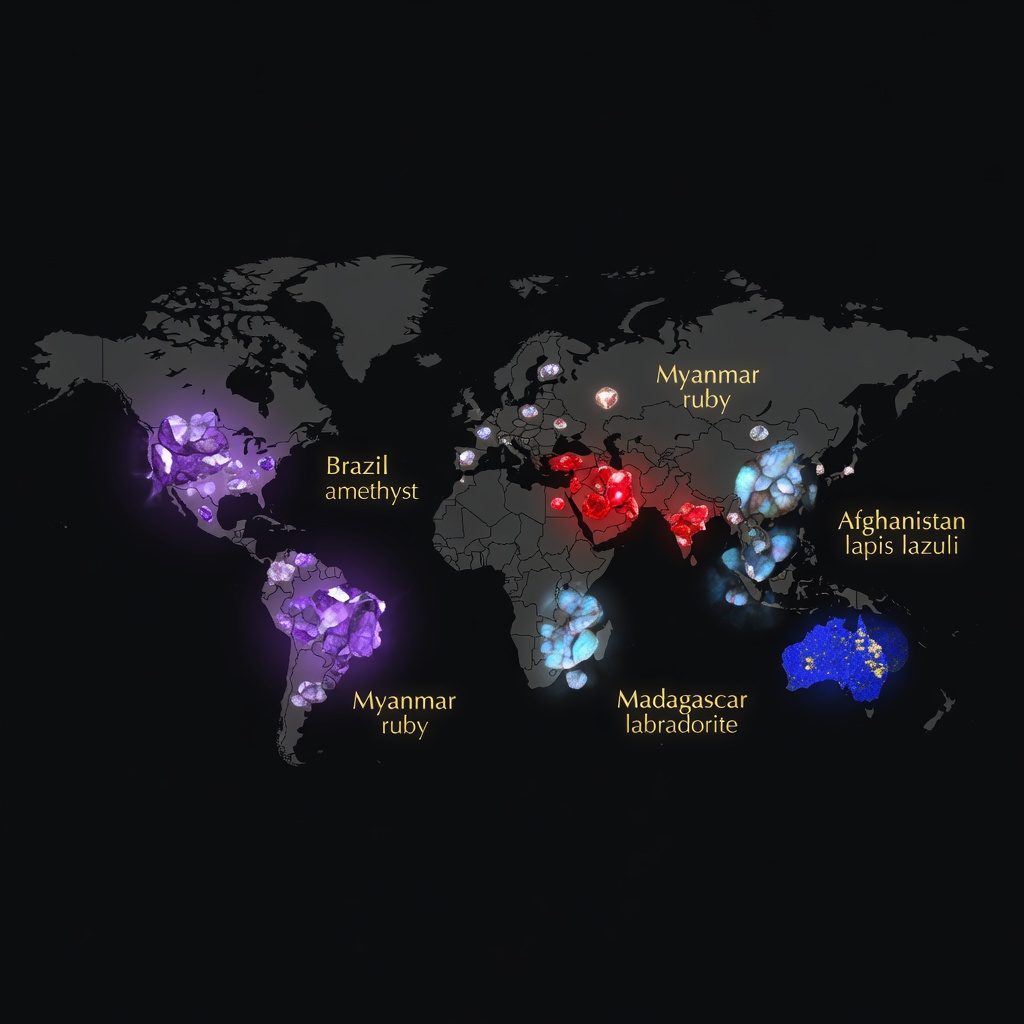
Brazil
The world's largest producer of gemstones, known for massive amethyst geodes and high-quality quartz.
Myanmar
Historically known as Burma, it produces the world's most prized 'pigeon blood' rubies and imperial jade.
Afghanistan
Home to the legendary Sar-e-Sang mines, producing the finest lapis lazuli for over 6,000 years.
Madagascar
A geological treasure island with unique variations of labradorite and rose quartz found nowhere else.
Colombia
Produces 70-90% of the world's emeralds, famed for their intense green color and exceptional clarity.
Russia
The Ural Mountains are famous for rare color-change alexandrite and deep green malachite.
South Africa
A major source of diamonds and unique spiritual stones like Tiger's Eye and the rare Sugilite.
Australia
Supplies 95% of the world's opals, including the magnificent black opal from Lightning Ridge.
Ethical Sourcing & Conscious Crystal Collecting
The crystal industry is largely unregulated. Here's how to make sure your stones are sourced with integrity — for the Earth and for the people who mine them.
Global Supply Chain
Most crystals pass through 4–7 countries before reaching you. Each handoff is an opportunity for exploitation — or for fair trade.
Human Impact
An estimated 1 million artisanal miners globally work in dangerous, unregulated conditions. Ethical purchasing creates accountability.
Environmental Cost
Irresponsible mining causes deforestation, toxic runoff, and ecosystem destruction. Sustainable sourcing protects the landscapes crystals come from.
"Every crystal you own has a story that began deep in the Earth. Choosing suppliers who tell it honestly is part of a conscious practice."
5 Signs of an Ethically Sourced Crystal
What to look for when buying
Transparent Origin
The seller can tell you exactly which country, region, and mine the crystal came from. Vague answers like 'Brazil' without specifics are a red flag.
Fair Trade Certification
Look for Fair Trade or similar certifications. While not universal in the crystal industry, responsible sellers often partner with certified cooperatives.
No Child Labor Policy
Reputable suppliers have explicit no-child-labor policies and audit their supply chains. Ask sellers directly — their willingness to answer tells you a lot.
Small-Batch & Artisanal
Artisanal and small-scale mining (ASM), when done responsibly, supports local economies and causes far less environmental damage than industrial mining.
Environmental Practices
Look for sellers who restore mining sites, limit chemical use, and work with local environmental groups. It's rare, but these sellers exist and deserve your support.
Red Flags to Watch For
Be cautious when you see these
Unrealistically low prices
High-quality crystals cost money to mine and transport responsibly. Suspiciously cheap stones often indicate labor exploitation or synthetic fakes.
No sourcing information
If a seller can't tell you where a stone is from, that's a major red flag. Ethical sellers are proud of their sources.
Dyed or heat-treated stones sold as natural
Common with citrine (most purple amethyst heated to orange), 'aqua aura' quartz (coated), and vivid green 'emeralds.' Always ask.
Mass-market mystery packs
Blind crystal boxes without origin info can be exciting but are rarely ethically sourced. Know what you're buying.
Our Sourcing Promise
Every crystal seller we recommend in our shop has been vetted for transparency about origin, fair pricing, and responsible sourcing practices. We only partner with sellers we trust.
We update our shop recommendations regularly as the industry evolves.